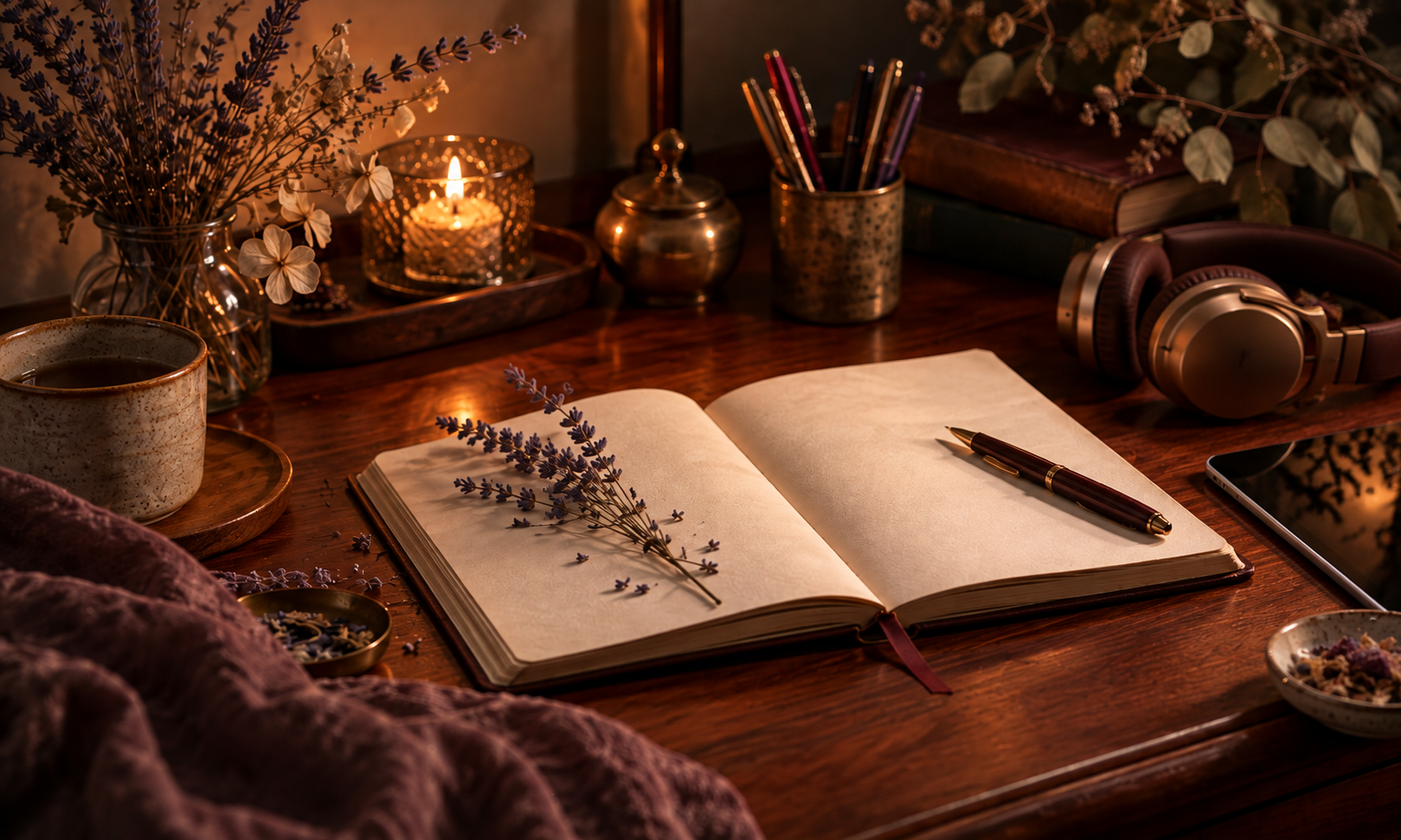
Some days, healing asks too much of us.
There is a version of self-care that arrives with checklists and streaks and a voice that sounds suspiciously like a deadline. I have met it. I did not like it.
And then there is another way. Quieter. Slower. The kind that doesn’t demand you become someone new by Friday, just that you notice yourself a little more kindly than yesterday.
I started Selfkind with more of a feeling than a plan, and that feeling was this: healing shouldn’t shout. It should sit beside you, the way late-afternoon light sits on a wall, and wait until you’re ready.
So here are some of the quiet ones. The gentle practices. None of them require you to be fixed first.
1. Writing without an audience
Words alone are not the only way back to yourself, but they are one of the ways.
There’s a difference between journaling for a self-improvement system and writing simply to hear what you actually think. The second kind has no audience, no polishing, no performance. You write the feeling down before it disappears, the way you’d scribble a dream before it fades.
Research has been quietly generous to this practice. A meta-analysis of expressive-writing studies found small improvements in symptoms of depression, anxiety and stress, sometimes emerging only after a little time. Writing is not a cure for everything, but it can be one gentle way to make space for difficult feelings.
Still, you don’t need the research beside you every time you pick up a pen. You only need the pen.
Try this: Tonight, write three lines. Not a page, just three. One for what you felt today, one for what you noticed, one for anything left unsaid. Then close the notebook like you’re tucking something in.
2. A walk that isn’t going anywhere
Not a workout. Not steps counted. A walk with no destination, where the pace is set by whatever your body wants that day.
There’s something quietly convincing in the research here too. A review of controlled studies on green-space exposure found that time in green spaces was associated with less fatigue and a greater sense of vitality. A walk doesn’t have to become another task to be worth taking.
I suspect most of us knew this already, in the way we know things before we can explain them. The light feels different near trees. So does the mind.
Try this: Walk to the nearest bit of green you can find, a park, a tree, a scruffy bit of weeds pushing through pavement. Stand there for one full minute. Notice five things. That’s the whole practice.
3. Breathing like nothing is urgent
The breath is the one instrument we all carry, and the only one that plays itself.
Gentle breathing, a slow inhale and an unhurried exhale, can be a quiet pause rather than another thing to get right. A review of breathwork trials suggests these practices may help ease stress for some people, although the evidence is still developing. No app required. No technique with a trademark. Just the oldest rhythm you own.
I like to do it while the kettle boils. The water and I both take a few minutes to warm up.
Try this: If it feels comfortable, breathe in for four, out for six. Five rounds. If those counts feel awkward, simply breathe at your own pace. If your mind wanders, wonderful. It came home, and that’s the practice.
4. Rest that doesn’t earn its keep
We are so good at making rest conditional. Rest after finishing. Rest after achieving. Rest as a reward for a body that collapsed politely.
But rest isn’t a prize at the end of usefulness. It’s the ground everything else grows from, one of those things that only made sense much later, like so many little moments do.
Some days, the most radical gentle thing you can do is lie down while the sun is still up and refuse to feel interesting about it.
Try this: Twenty minutes of nothing. No podcast, no screen, no productivity in disguise. If guilt arrives, let it sit in the chair while you stay on the sofa.
5. Speaking to yourself like someone you love
If a friend came to you and said, “I tried, and I failed, and I feel terrible,” you would not say, “Well, you should have planned better.” You’d be kind. You’d probably make tea.
Self-compassion is mostly just that, but pointed inward, which turns out to be the hard direction.
Research offers some support here too. A meta-analysis of self-compassion interventions found improvements in reported stress, anxiety and depressive symptoms, though the studies had important limitations. But beyond the research, there’s a simpler truth. The way we speak to ourselves becomes the room we live in.
Try this: Next time you stumble, write down what you’d say to a friend in the same spot. Then, and this is the whole trick, say it to yourself. Out loud if you’re brave. In the bathroom, if you’re not.
6. Letting art do the talking
Some feelings refuse grammar. They will not be written, explained, or scheduled. That’s when painting, music, film, or a photograph steps in, languages for the parts of us that words alone can’t reach.
This is, quietly, the heart of Selfkind. Not art as achievement. Art as a door you didn’t know was there.
A painting doesn’t need to be good. A playlist doesn’t need to be profound. You just need to let something outside you touch something inside you, and, for a second, understand yourself a little better.
Try this: Choose one song that finds you every time. Listen to it doing nothing else. Just that. Just listening, with your whole attention, like the song knows what you couldn’t explain.
A closing thought
None of these are a method. I certainly wasn’t following a plan when I collected them. They’re just the small things that made me stop, feel, question, remember, or look at myself differently.
Little things. Moments.
Healing, when it’s gentle, doesn’t feel like healing at the time. It feels like an ordinary Tuesday in which you were slightly kinder to yourself than the day before. Only much later do you look back and realise something rather lovely.
You didn’t know you were building something.
But maybe you were.
Just very, very slowly.
This is a personal reflection, not medical or psychological advice. If you’re carrying something heavy, please don’t carry it alone. A qualified therapist or doctor can walk with you, and being helped by a professional is one of the gentlest practices of all.
Leave a Reply